
Billionaire Pham Nhat Vuong is deploying a US $5.6 billion super-railway unprecedented in history: Nearly 40 construction teams across 4 provinces and cities need to cast 3,200 girders for the entire route
Updated: 04/10/2026
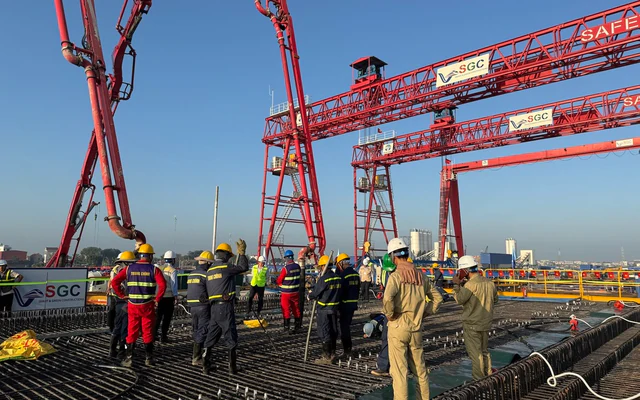
SGC contractor mobilized 12 experts and 50 skilled technical workers on site to create the first beam that met the standard right from the opening casting.
On October 1, VinSpeed High Speed Railway Investment and Development Joint Stock Company and the construction contractor of SGC Investment and Construction Joint Stock Company successfully cast the first typical beam for the Hanoi - Quang Ninh high-speed railway.
This is the main bearing structure, which is decisive in shaping the entire overhead route of this inter-regional route. With a length of up to 120.4 km, the Hanoi - Quang Ninh route is expected to need about 3,200 typical girder slabs, not to mention special girder systems at complex terrain crossing locations.
Each standard girder slab has a length of 32.6 m, a width of 12.6 m and a height of 3,015 m, consuming up to 280 m³ of concrete. In order to ensure the durability and absolute uniformity of the structure weighing hundreds of tons, all of the above concrete is poured continuously for 6 hours.
The project applies post-tensioned reinforced concrete technology – the current leading technical solution for large span viaducts. When the concrete block reaches the designed strength, the high-strength cable bundles threaded inside will be stretched with great compressive force, helping the beam suppress deformation, withstand the load of high-speed trains and optimally control material cracks during decades of commercial operation.
Mobilize a network of 8 North beam casting yards
In order to create the first beam slab to meet the standard right from the opening casting batch, SGC contractor mobilized 12 experts and 50 skilled technical workers on site. Notably, in order to meet the huge volume of components of the route, 6 out of 8 large-scale beam casting yards in the northern area have been basically completed and prepared to be put into production line simultaneously.
The entire production process of beams at the yard is mechanized to the maximum extent. Reinforced cage is processed on specialized platforms, then lifted by 80-ton crane and assembled correctly into the formwork system. The motorized sliding core formwork system combined with automatic vibrating compactor ensures that the concrete mixture is compacted, smooth and uniform on the entire beam structure.
When completed, specialized girder forklift trucks with a capacity of up to 900 tons will transport the girder slab to the storage yard, ready for the super-weighted convoys to take to the route to rush to install on the abutment.
Deploying nearly 40 construction teams simultaneously
Starting from April 12, 2026, the Hanoi – Quang Ninh high-speed railway project has a total investment of more than 147,000 billion VND, equivalent to over 5.6 billion USD (excluding ground clearance costs). The route goes through 4 key localities in the North including Hanoi, Bac Ninh, Hai Phong and Quang Ninh.
The whole line is designed according to the 1,435 mm double track technical standard, electrified the whole line, the maximum design speed is up to 350 km/h and the axle load is 17 tons. The route starts from Co Loa station (Hanoi), connected through 3 transit stations including Gia Binh (Bac Ninh), Ninh Xa (Hai Phong), Yen Tu (Quang Ninh) before finishing at Ha Long Xanh station (Quang Ninh), accompanied by 2 modern technical depots.

View of Ha Long station at Global Knowledge Park, Vinhomes Global Gate Ha Long, Quang Ninh.
Currently, the investor and contractors are focusing on deploying nearly 40 construction teams at the same time. In parallel with the mass casting of beams, the drilling of bored piles crossing large rivers on the route and the site clearance in the localities are also being accelerated to the maximum.
The milestone of mastering the technology of casting large span beams on October 1 marks the project has officially entered the stage of speeding up the construction of the upper structure. When completed and put into commercial operation in 2028 - 2029, this super project will shorten the travel time between Hanoi and Ha Long to only about 23 minutes, 5–7 times faster than the current road, creating a historic push for the northern economic triangle.
No items yet.
No items yet.